McSchneider Design Studios
Oh Hell
Game Night
A trick-taking game with one cruel twist: before a card is played, you have to say exactly how many tricks you're going to win. Land it and you score. Miss by one — in either direction — and you get nothing at all.
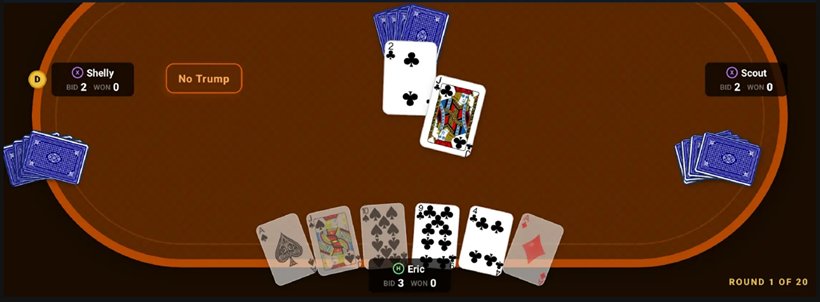
Most card games reward taking more. This one punishes it.
Oh Hell — also played as Oh Pshaw, Blackout, Nomination Whist and a dozen other names — is a trick-taking game for three to seven players. Every round you're dealt a hand, you predict how many tricks you'll take with it, and then you have to be right. Taking one trick too many is exactly as bad as taking one too few, which means half the game is trying to lose tricks on purpose.
The whole game, in five steps
If you've played Spades or Euchre you already know most of this. The bidding is where Oh Hell parts company with both.
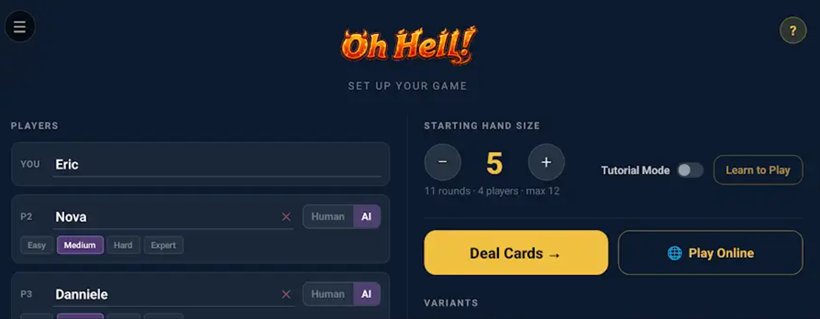
Every round deals a different number of cards
Round one might be eight cards each; the next is seven, then six, all the way down to a single card. Then it climbs back up. That's the default down, no-trump, up structure — the hand shrinks to nothing, passes through one round with no trump suit at all, and grows again.
It matters because a bid of two means something completely different with eight cards in your hand than it does with two. The app picks the number of rounds from the starting hand size you choose and the number of players at the table.
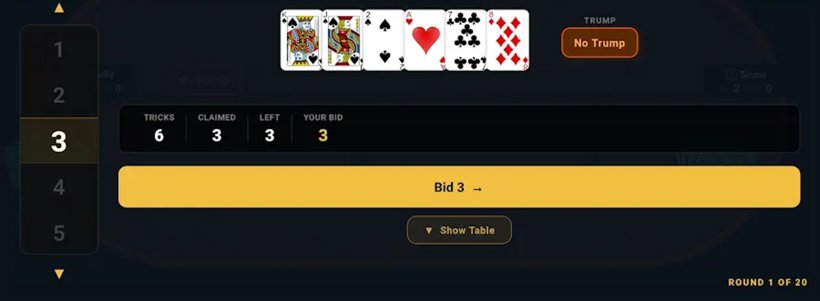
Say exactly how many tricks you'll win
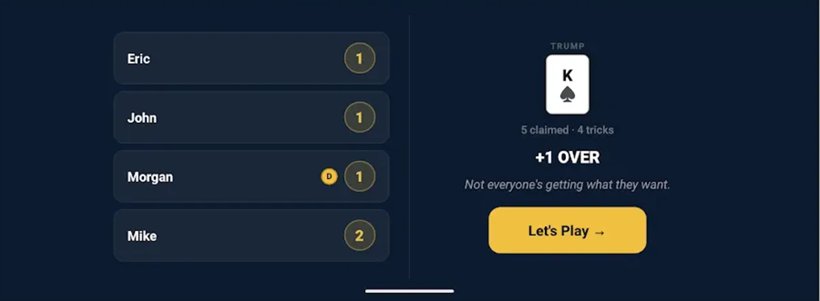
Once you've seen your hand, you commit to a number. That's your bid, and you can't change it. The panel keeps the arithmetic in front of you: how many tricks exist this round, how many the players before you have already claimed, and how many are still unspoken for.
You're allowed to bid zero. Sitting on a hand of low cards and successfully taking nothing at all is one of the most satisfying things in the game.
Somebody is going to be wrong
Before the first card, one card is turned face up from the undealt pile and its suit becomes trump for the round — any trump card beats any card of any other suit. One round in the middle of the game is played with no trump at all, and it plays completely differently.
Then the bids are totalled. If the table has claimed more tricks than the round contains, somebody has to come up short. If it has claimed fewer, somebody is going to be forced to take one they didn't want. The app spells out which way it's leaning.
Play it out, trick by trick
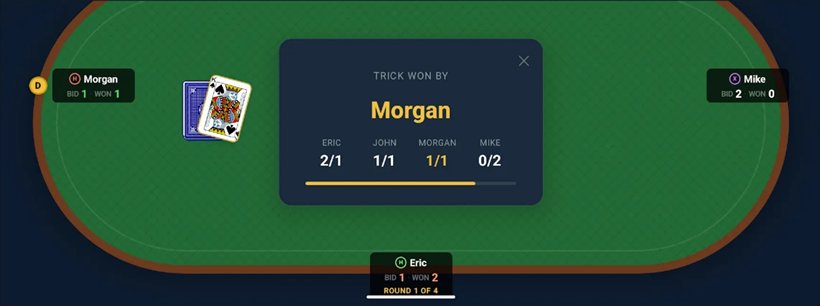
The player to the dealer's left leads any card. Everyone else must follow the suit that was led if they hold it — the app greys out anything you're not allowed to play, so you can't get it wrong. Only if you're void in that suit can you play something else, including trump.
The highest card of the led suit takes the trick, unless somebody trumped in, in which case the highest trump takes it. The winner of each trick leads the next. Every player's bid and tricks-won sit beside their name the whole way through, so you always know who still needs what.
Exact, or nothing
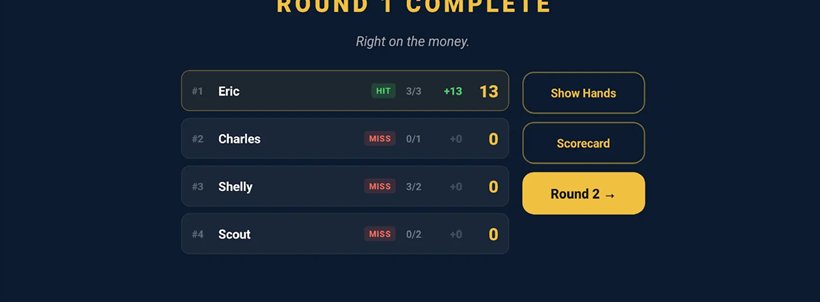
When the last trick of the round is played, everyone is scored. Hit your bid precisely and you take 10 points plus the number you bid — so a successful bid of three is 13, and a successful bid of zero is still a perfectly respectable 10.
Miss it by any amount, in either direction, and you score zero. There is no partial credit and no consolation for coming close. Then the deal moves on, the hand size changes, and it starts again.
Green or red. Nothing in between
The scorecard is the whole game at a glance — every round, every player, what they bid against what they took, and the running total underneath.
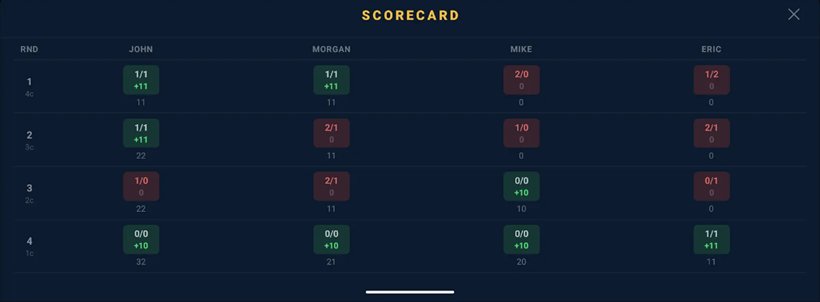
Because a miss is worth nothing at all, the leaderboard moves in lurches rather than creeping. A player can sit on zero for three rounds and then take the lead in one. The highest total when the last round is scored wins the game.
Round a table, or nowhere near one
Pass and play on one phone
Everyone shares a single device and hands it on. Your cards are hidden until it's your turn, so nobody sees a hand they shouldn't.
Or online, with a code
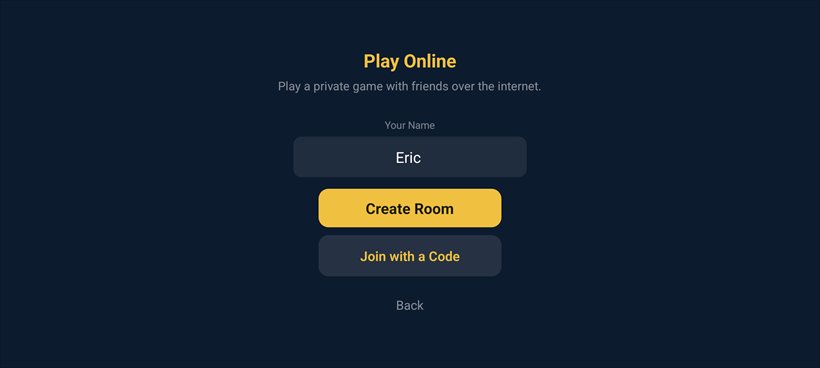
Create a room, send the four-character code to whoever you want, and they join from their own phone. No accounts, no friend lists, no lobby full of strangers.
Empty seats fill themselves
Short a player? Any seat nobody takes is played by a bot, so a game of three still works. You can set how hard the bots play — easy through expert.
Everyone plays it slightly differently
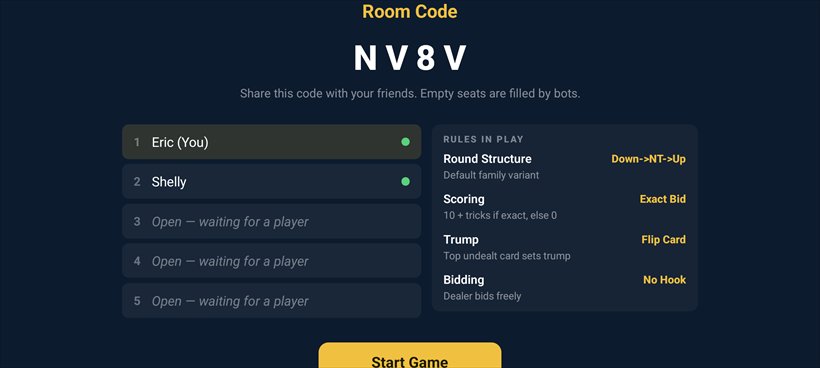
Oh Hell has been passed around families for decades, and almost every one of them has picked up a house rule. The ones that matter are settings, not arguments — and whatever a room is using is written down where everyone can see it.
Round structure
The default counts the hand size down, plays a no-trump round at the bottom, then counts back up. Other tables just go down, or just go up.
How trump is chosen
Flipping the top undealt card is the common way. It can also be fixed, rotated, or dropped entirely.
Whether the dealer is hooked
Some families won't let the dealer bid a number that would make everyone's bids add up to the tricks available — the "hook", or screw-the-dealer. Off by default; the dealer bids freely.
New to it?
Turn on tutorial mode and the app talks you through what's happening as you play, or take the Learn to Play walkthrough before you deal a single hand.
Somebody gets to be insufferable
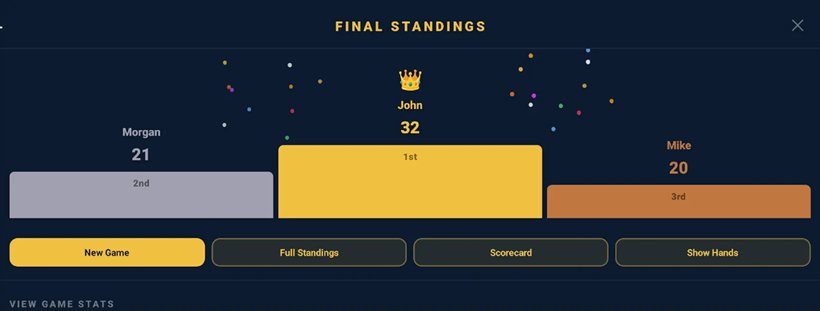
The last round is scored, the totals are final, and the most precise player — not the greediest one — takes it.
Deal a hand tonight
Oh Hell — Game Night is free on iPhone, iPad and Android. No account needed.